Parking on the pavement is banned in some parts of the UK and restricted in others. Here motoring journalist and expert Pete Barden looks at the latest rules for England,
London, Scotland, Wales and Northern Ireland, including the new powers being introduced in England in
2026.
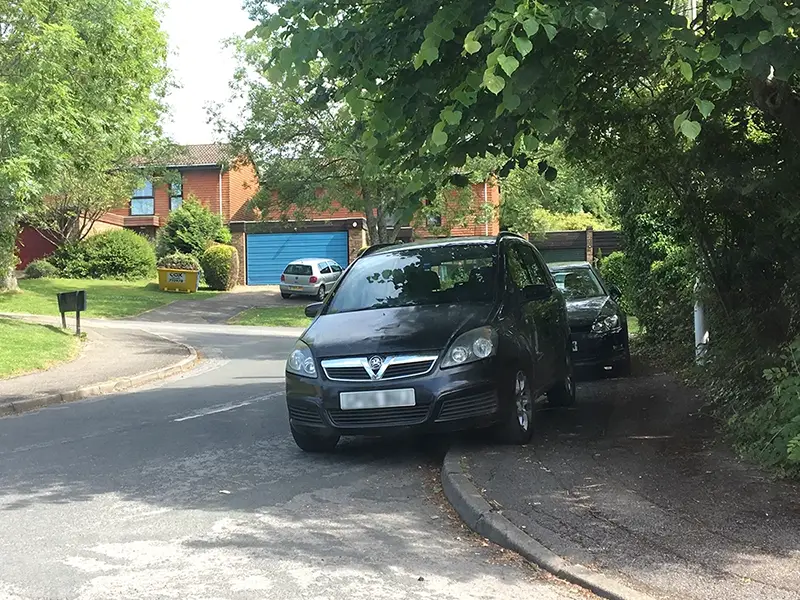 Parking
on pavements is dangerous and can put pedestrians at risk - but is it illegal where you are? This is
near two schools. (Credit: Pete Barden)
Parking
on pavements is dangerous and can put pedestrians at risk - but is it illegal where you are? This is
near two schools. (Credit: Pete Barden)
New pavement parking rules for 2026
Pavement parking rules in England are changing, but there is not
a blanket ban across England.
The Government confirmed in January 2026 that local authorities
in England will be given new powers to tackle pavement parking and introduce
restrictions across wider areas.
At present, councils in England outside London can already
enforce pavement parking in certain circumstances, including where vehicles breach
existing waiting restrictions such as yellow lines, where a local prohibition has been
introduced through a Traffic Regulation Order, or where a heavy commercial vehicle over
7.5 tonnes is parked on the pavement.
The new approach is designed to make it easier for councils to
introduce wider pavement-parking restrictions where they believe parked vehicles are
causing problems for pedestrians.
The important point for drivers is that pavement parking
does not automatically become illegal everywhere in England in 2026.
Whether you can park on a pavement will depend on the location,
signs, markings and restrictions introduced by the relevant local authority.
Drivers should therefore check local signs and parking restrictions rather than
assuming pavement parking is either always legal or always banned.
Is it currently illegal to park on the pavement?
It depends on where you are in the UK.
Pavement parking is subject to different rules in England, London, Scotland, Wales
and Northern Ireland.
In London, parking partly or wholly on the pavement is generally
prohibited unless specifically permitted.
In Scotland, there is a nationwide pavement-parking ban, subject
to certain exemptions.
In England outside London, there is currently no blanket
nationwide ban, although councils can enforce pavement parking in certain circumstances and new powers are
being introduced to make wider restrictions easier.
In Wales, there is currently no nationwide pavement-parking ban
equivalent to Scotland's.
In Northern Ireland, there is also no general ban on footway
parking, although parking restrictions and obstruction laws can apply.
Wherever you park, you must not leave your vehicle in a dangerous position or where it causes unnecessary
obstruction.
Pavement parking in London
Parking partly or wholly on the pavement is generally banned in
London.
The ban dates back to 1974 and applies across Greater London.
There are some streets where pavement parking is specifically permitted. These
locations are indicated by signs and/or marked parking bays.
If there is no indication that pavement parking is permitted, you should keep all
four wheels on the road.
How to report illegal pavement parking in London
If you spot a car that is illegally parked on the pavement,
then you should report it to the local council. You can find the local council here by adding the postcode of
where the car is parked.
However, if the pavement parking involves a car being parked on the pavement on zigzag lines, on a drop
kerb where pedestrians cross the road, near a school entrance, bus or tram stop, you can report these to the
Metropolitan Police here.
Pavement parking outside London
Outside London, there is no blanket ban on pavement parking across England.
Highway Code Rule 244 says drivers should not park partially or wholly on the
pavement unless signs permit it.
However, that wording is different from the legal prohibition applying in London.
There are circumstances where pavement parking can still result in enforcement
action.
For example, yellow-line restrictions apply to the carriageway and pavement, while
councils can introduce local restrictions prohibiting pavement parking.
Drivers must also comply with Highway Code Rule 242, which says:
“You MUST NOT leave your vehicle or trailer in a dangerous position or
where it causes any unnecessary obstruction of the road.”
So a driver should not assume that pavement parking is automatically safe or legal
simply because they are outside London.
Local signs, yellow lines, parking restrictions and the circumstances of the parking all need to be
considered.
Rule 243 gives more insight into dangerous areas where vehicles are parked on pavements that should be
reported to police. It states:
DO NOT stop or park:
- near a school entrance
- anywhere you would prevent access for Emergency Services
- at or near a bus or tram stop or taxi rank
- on the approach to a level crossing/tramway crossing
- opposite or within 10 metres (32 feet) of a junction, except in an authorised parking space
- near the brow of a hill or hump bridge
- opposite a traffic island or (if this would cause an obstruction) another parked vehicle
- where you would force other traffic to enter a tram lane
- where the kerb has been lowered to help wheelchair users and powered mobility vehicles
- in front of an entrance to a property
- on a bend
- where you would obstruct cyclists’ use of cycle facilities
- except when forced to do so by stationary traffic.
These apply to both pavement parking and parking on the road.
This rule means police can penalise drivers if they decide their parking is dangerous or in any way
causes an obstruction of the road – even if it is legal to park on the pavement.
UK pavement parking rules at a glance
| Area |
Pavement parking position |
| London |
Generally banned unless specifically permitted |
| Scotland |
Nationwide ban, subject to exemptions |
| England outside London |
No blanket ban, but local restrictions and existing laws can be enforced; new powers
are being introduced |
| Wales |
No nationwide pavement-parking ban |
| Northern Ireland |
No general ban, although parking restrictions and o |
Subscribe for free motoring and travel news here - support independent journalism
Is there a pavement parking ban in Scotland?
Yes.
Scotland has a nationwide ban on pavement parking.
The ban came into force on 11 December 2023, giving local
authorities powers to enforce the rules.
Drivers who breach the pavement-parking prohibition can receive a £100
Penalty Charge Notice, reduced to £50 if paid within 14 days.
There are some exemptions, including specific locations where local authorities
have formally exempted pavement parking.
The ban also covers parking with one or more wheels on the pavement, so drivers
should not assume that leaving only part of the vehicle on the footway is allowed.
Can Blue Badge holders park on the pavement in Scotland?
The pavement-parking ban applies to Blue Badge holders too, although separate
parking concessions may apply in other circumstances.
Blue Badge holders should check the specific rules and exemptions rather than assuming the badge allows
pavement parking.
Is there a pavement parking ban in Wales?
No – there is currently no nationwide pavement-parking ban in
Wales.
However, pavement parking can still be restricted locally, and drivers must not
park in a way that causes danger or unnecessary obstruction.
The Welsh Government has previously considered changes to the law to give local
authorities greater powers to deal with pavement parking.
For drivers, the important point is that you should not assume pavement parking is
automatically permitted simply because Wales does not have Scotland's nationwide ban.
Check local signs, yellow lines and parking restrictions, and make sure your vehicle does not obstruct
pedestrians or other road users.
Is there a pavement parking ban in Northern
Ireland?
No – there is currently no general ban on pavement parking in Northern
Ireland.
The Northern Ireland Government says that, apart from urban clearways, there is no
general ban on footway parking.
Where there are no parking restrictions marked on the road, a parking ticket cannot
generally be issued simply because a vehicle is parked on the pavement.
However, if a vehicle causes an obstruction, the situation can be dealt with by the
PSNI.
Drivers should also obey any local parking restrictions, yellow lines and signs
that apply to the location.
So while pavement parking is not subject to a general ban in Northern Ireland, that does not mean drivers
have an unrestricted right to block a pavement.
Why are pavement parking rules so confusing?
Pavement parking is confusing because the rules are different across the UK.
A driver in Scotland is subject to a nationwide ban, while a driver in England
outside London does not face the same blanket prohibition.
London has had a pavement-parking ban for decades, while Wales and Northern Ireland
currently have different arrangements.
The introduction of new powers for councils in England during 2026 is likely to make local restrictions
more important, so drivers should check signs and restrictions where they park.
What about electric cars being charged on the
pavement?
Owning an electric car does not give you a special right to park on the pavement.
EV drivers must follow the same pavement-parking rules as other motorists.
You could also create a hazard for pedestrians by running a charging cable across a
pavement.
If you need to charge an electric car at home, check your local authority's guidance and make sure
any charging arrangement does not obstruct pedestrians or create a trip hazard.
Can you park partly on the pavement?
The rules depend on where you are.
In London, parking partly or wholly on the pavement is generally
prohibited unless specifically permitted.
In Scotland, the national pavement-parking ban covers vehicles
parked partly or wholly on the pavement, subject to exemptions.
In England outside London, there is no blanket national ban, but
local restrictions, yellow lines and obstruction laws can still apply.
The safest approach is not to put any part of your vehicle on the pavement unless you know that parking
there is permitted.
Can you park on the pavement outside your house?
Owning or living at a property does not give you an automatic right to park
on the pavement outside it.
The pavement forms part of the highway and parking restrictions can apply
regardless of who lives at the property.
In England outside London, whether pavement parking is permitted depends on the
applicable local restrictions and circumstances.
In London and Scotland, much stricter rules apply.
If parking outside your home blocks pedestrians, creates an obstruction or breaches a parking
restriction, you could face enforcement action.
What is the fine for parking on the pavement?
There is no single UK-wide fine for pavement parking.
The penalty depends on where the vehicle is parked and which rule or restriction
has been breached.
In Scotland, the national pavement-parking penalty is
£100, reduced to £50 if paid within 14 days.
In London, pavement parking is generally prohibited and the
relevant Penalty Charge Notice depends on the location.
In England outside London, the penalty can depend on the local
restriction or whether the vehicle is being dealt with for obstruction or another parking offence.
In Wales and Northern Ireland, local restrictions and other
parking or obstruction laws can also apply.
So don't assume that every pavement-parking offence carries a standard £100 fine.
Can you report someone parking on the pavement?
Yes, but who you report it to depends on the circumstances.
If a vehicle is subject to a local parking restriction, you can normally report it to the relevant council or parking
enforcement authority.
If the vehicle is causing a dangerous obstruction, particularly by forcing
pedestrians into the road, you may need to contact the police.
Take photographs showing the vehicle, registration number and the obstruction if it
is safe to do so.
Do not put yourself in danger to photograph or report a vehicle.
The bottom line
Can you park on the pavement? It depends on where you are.
- London: generally banned
- Scotland: nationwide ban, subject to exemptions
- England outside London: no blanket ban, but local restrictions and obstruction laws
apply, with new council powers being introduced in 2026
- Wales: no nationwide ban
- Northern Ireland: no general ban, although restrictions and obstruction laws apply
The safest option is to keep your vehicle completely off the pavement unless you
know that parking there is permitted.
And wherever you park, don't leave your vehicle in a dangerous position or where it causes
unnecessary obstruction.
Latest motoring news and guides
Take a look at more of our top motoring-related content here...
Subscribe for free motoring and travel news from PeteBarden.co.uk
About
us: Pete Barden Motoring and Travel News