Confused by the letters and numbers on your UK driving licence? From code 01 for eyesight correction to code 78 for automatic vehicles, the information on your photocard tells you what you can drive and any conditions or restrictions you must follow.
Here motoring journalist and expert Pete Barden looks at what some of the important and popular codes mean to help you read and understand your licence.
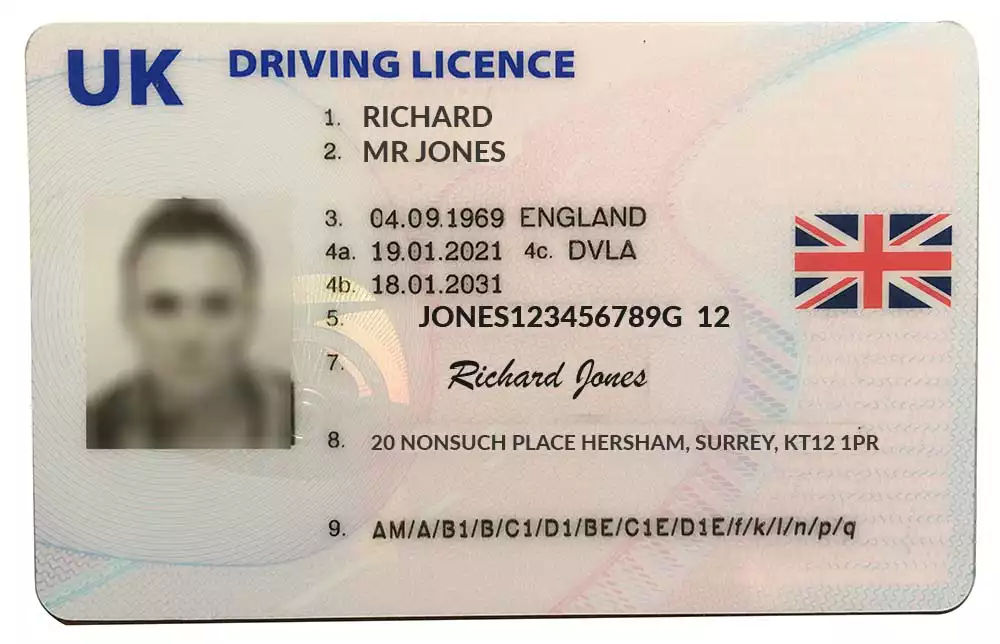 Here are the sections on the front of a UK driving licence.
(Credit Pete Barden)
Here are the sections on the front of a UK driving licence.
(Credit Pete Barden)
How to read the front of your UK driving licence
Here’s what the sections say about you and your driving.
Your Details
Section 1: Your surname
Section 2: Your first and middle name
Section 3: Your date of birth and where you were born
Details and expiry date of your licence
What does 4a mean on a driving licence?
4a is the date your driving licence was issued.
What does 4b mean on a driving licence?
4b is the date your photocard driving licence expires. You normally need to renew your photocard before this date.
Section 4c: Where the driving licence was issued
Section 5: Your individual driving number
Section 7: Your signature
Section 8: Your address – if this is wrong, you could be fined £1,000
Section 9: These are the categories of vehicles you can drive all listed in one place. The reverse of the driving licence explains these in greater detail – as have we, below.
Subscribe for free motoring and travel news here - support independent journalism
How to read the back of your UK driving licence
The front of your UK driving licence contains your personal details, licence number, issue and expiry dates and vehicle categories. The back shows the vehicle categories you can drive, the dates those entitlements are valid and any restrictions or conditions shown by codes in column 12.
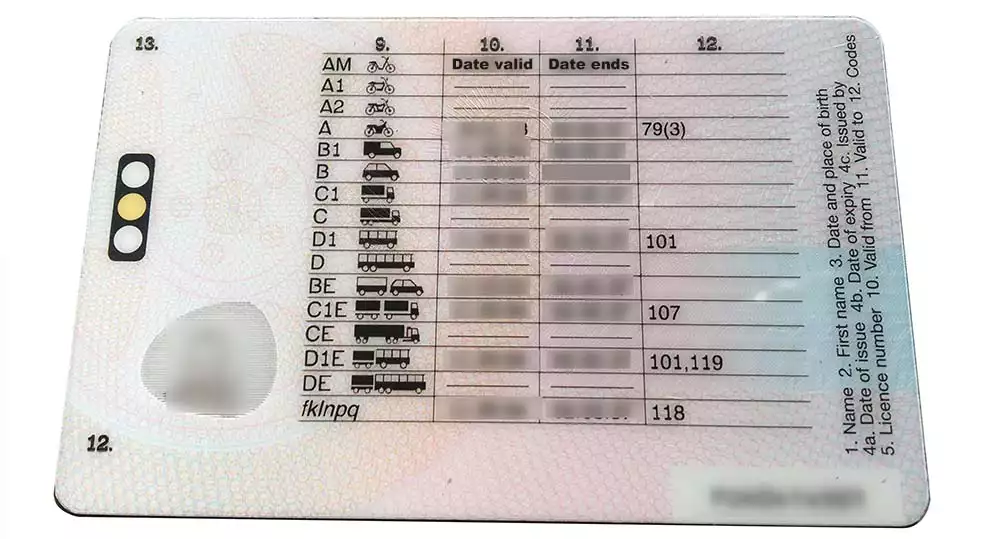 Here are the categories and
columns for dates they are active (we have blurred the dates to protect the licence holder's
privacy. (Credit Pete Barden)
Here are the categories and
columns for dates they are active (we have blurred the dates to protect the licence holder's
privacy. (Credit Pete Barden)
Column 9: The types of vehicle you are allowed to drive
Columns 10: and 11: From and to dates that you can drive the vehicles listed in column 9 – if applicable. No date means you can’t drive or ride that category.
What do the codes in column 12 mean?
The numbers in column 12 show conditions or restrictions that apply to the vehicle category listed on that row. They can tell you, for example, that you must wear glasses, drive an automatic vehicle or comply with a particular vehicle restriction.
Look out for these codes in column 12:
| Code | What it means |
|---|---|
| 01 | Eyesight correction, such as glasses or contact lenses |
| 02 | Hearing or communication aid |
| 78 | Automatic transmission only |
| 96 | Vehicle and trailer combination between 3,500kg and 4,250kg in the circumstances specified |
| 101 | Not for hire or reward |
| 105 | Vehicle no more than 5.5 metres long |
| 106 | Automatic transmission |
| 115 | Organ donor |
| 118 | Start date is for earliest entitlement |
| 121 | Restricted to conditions specified in the Secretary of State's notice |
| 122 | Valid on successful completion of the Basic Moped Training Course |
Licence categories for motorbikes
AM: This category applies to mopeds, meaning you can drive two-wheeled or three-wheeled vehicles at a maximum speed of 28mph - including quad bikes. You must be at least 16 years old to hold an AM licence and have passed your motorbike theory and practical test.
A1: Allows holder to ride motorbikes with an engine of up to 125cc with a power input up to 11kW, and tricycles with a power input up to 15kW. To hold this, you need to be at least 17 and have passed your motorbike theory and practical test.
A2: Motorbikes up to 35kW and you must be at least 19 years old and have taken your theory and practical test.
A: Holders can drive any bike of any size or engine. You must be 24 years old to get this licence or 21 years old if you’ve held your A2 licence for more than 2 years and have passed both a motorbike theory and practice test.
Licence categories for cars
B1: You can drive a vehicle with 4 wheels up to 400kg unladen or 550kg if designed for carrying goods.
B: This on your licence allows you to drive a manual or automatic car, or both if you passed using a manual car.
Licence categories for lorries and buses
C1: You can drive vehicles between 3,500 and 7,500kg maximum authorised mass (MAM) - with a trailer up to 750kg
C: You can drive any vehicle over 3,500 kg - with a trailer up to 750kg MAM
D1: You can drive minibuses with no more than 16 passenger seats, a maximum length of 8 metres and a trailer up to 750kg.
D: You can drive any bus with more than 8 passenger seats and a trailer up to 750kg.
Licence categories for trailers
BE: Allows drivers who passed their driving test after 1st January 1997 to tow trailers up to 3,500 kg MAM with a standard driving licence without of passing any additional tests or qualifications.
C1E: Lets drivers drive C1 vehicles with a trailer of over 750 kg. The combined weight can’t exceed 12,000kg MAM.
CE: Same as Category C apart from it allows you to tow a trailer over 750kg.
D1E: Means you can drive D1 minibuses and tow a trailer over 750kg with a weight not exceeding 12,000kg MAM.
DE: Allows you to drive buses seating more than 8 passengers together with towing a trailer over 750kg
Common driving restrictions on your licence
Look out for these in column 12 on the rear of your licence. You must comply with them or risk fines.
01 – Eyesight correction (i.e. the use of glasses whilst driving)
02 – Hearing Aid
40 – Modified Steering
78 – Restricted to automatic transmission vehicles
105 – Vehicle no more than 5.5m long
115 – Organ donor
What is the difference between driving licence categories and codes?
Driving licence categories tell you what types of vehicle you are entitled to drive.
Driving licence codes show conditions or restrictions attached to that entitlement.
For example:
B = car entitlement
01 = eyesight correction
78 = automatic transmission only
Where can I check for penalty points?
If you have the old green or pink paper driving licence, you will see them written on it. The new photocard licences don’t, so you will need to use the online tool to check your licence for penalty points.
Find out more about licence codes and categories here at the Gov.UK DVLA website.
What does the traffic light sign on the back mean?
Rumour has it that this symbol relates to having points on your licence, but this is not the case.
The symbol - which looks like a set of traffic lights with the amber light illuminated - can be found
on photocard licences issued after February 2014. Older licences may have a steering wheel symbol.
In both cases, they have nothing to do with points on the licence or pending penalties, and merely act
as a security feature that does not reflect your driving record at all. This was confirmed by the DVLA.
 Share
Share Post
Post Pin
Pin Email
Email Share
Share Share
Share
Most read motoring content
Take a look at more of our top motoring-related content here...
-
How much is road tax going up on 1 April?
-
What happens to a car when the owner dies?
-
Will I get a speeding ticket after being flashed
-
Do I need to wear a mask in my car under Plan B restrictions?
-
Can I be fined if the car park ticket machine is not working?
-
Is the M6 Toll Road free on Christmas Day?
-
How much is the Tamar Bridge toll and when do I need to pay it?
-
Do I need an electric car licence and driving test in the UK?
-
How can I find out who owns a car
-
Will I get a 6-month MOT extension because of the new Omicron variant this Christmas?
-
Do I need an international driving permit for France and Spain
-
How to spot a fake undercover police car
-
Is my green paper driving licence still valid and how much to swap for a photocard?
-
Can I drive in sliders in the UK - with or without socks
-
Electric car charging points at UK airports for public use
-
Are electric scooters a good Christmas present - find out the driving rules here
-
Are my sunglasses legal for driving?
-
Secret parking offences you're committing revealed
-
How old are my tyres - find out instantly here
-
What are the black dots on my windscreen for?
-
How far and how fast can I drive on a space saver spare wheel
Author: Pete Barden:
Twitter: @pete_barden
Pete Barden is a qualified journalist who has written and produced for publications including The Sun (thesun.co.uk), New Statesman Media Group, Whatcar? (Whatcar.com) Stuff Magazine (Stuff.tv), Fastcar Magazine (Fastcar.co.uk), Maxim Magazine and UK broadcast stations within the Heart network (Formerly GCAP). Pete specialises in motoring and travel content, along with news and production roles. You can find out more about Pete Barden on LinkedIn.
Read all articles by Pete Barden